

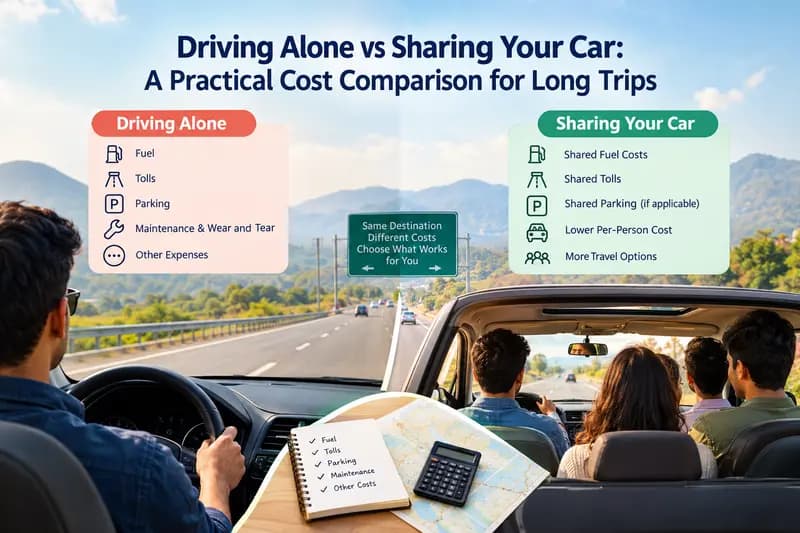
Driving Alone vs Sharing Your Car: A Practical Cost Comparison for Long Trips
Compare driving alone vs carpooling for long trips in India. Learn how sharing fuel, tolls, and other travel expenses can help reduce your personal travel costs.
Driving Alone vs Sharing Your Car: A Practical Cost Comparison for Long Trips
Planning a long road trip in India offers freedom, convenience, and the opportunity to explore places at your own pace. However, the cost of a road trip in India can add up quickly when you consider fuel, highway tolls, parking, vehicle maintenance, and other travel expenses. What initially seems like an affordable journey may become expensive when you pay for everything yourself.
This is where understanding driving alone vs carpooling becomes useful. You can either cover the entire journey cost independently or share your car with passengers travelling along a similar route. When everyone agrees on a fair expense-sharing arrangement, carpooling can reduce the driver's personal contribution while providing passengers with another intercity travel option.
However, the actual savings depend on several factors, including your car's mileage, fuel prices, route, toll charges, number of passengers, and which expenses are shared. Let's compare both options with realistic examples to understand when each approach makes financial sense.
What Does It Really Cost to Drive Alone?
Driving alone means you have complete control over your journey, but you are generally responsible for all the expenses associated with the vehicle and trip. To calculate the cost of driving alone for long trips, you should consider both immediate payments and the longer-term cost of using your car.
Fuel Expenses
Fuel is often one of the largest direct expenses during a long-distance road trip. The amount you spend depends on the distance travelled, your car's fuel efficiency, the price of petrol or diesel, and your driving conditions.
You can estimate your fuel expenses using this formula:
Fuel Cost = (Distance ÷ Mileage) × Fuel Price Per Litre
For example, suppose you are travelling 500 km in a car that delivers an average mileage of 15 km per litre. If the assumed fuel price is ₹100 per litre, the calculation would be:
Distance: 500 km
Average mileage: 15 km per litre
Estimated fuel required: 500 ÷ 15 = 33.33 litres
Assumed fuel price: ₹100 per litre
Total fuel cost: 33.33 × ₹100 = approximately ₹3,333
These figures are illustrative assumptions, not current fuel-price data or a guaranteed estimate for every vehicle. Actual mileage may change with traffic, air-conditioning use, road conditions, vehicle load, and driving habits.
If you regularly travel between cities, calculating fuel expenses before departure can help you compare solo driving with other travel options.
Highway Tolls and Parking
Highway tolls are another important part of long-distance travel expenses. Depending on your route, you may cross several toll plazas, and the total amount can vary considerably.
Parking charges may also apply when you reach your destination, particularly if you visit commercial areas, tourist attractions, hotels, or paid parking facilities.
When calculating your journey budget, check the toll charges applicable to your actual route and include any expected parking fees. Do not assume that every highway journey will have the same toll cost.
If you drive alone, you generally pay these charges yourself. When travelling with passengers, you may agree to share eligible toll expenses, although the arrangement should be clear before the journey begins.
Vehicle Wear and Tear
The cost of driving extends beyond fuel and tolls. Every journey contributes to the use of your vehicle, including tyre wear, routine servicing, and other maintenance requirements.
There is also depreciation, which represents the reduction in your vehicle's value over time. Distance travelled, vehicle age, condition, and market demand can influence depreciation.
These expenses are different from immediate out-of-pocket payments. You may not need a tyre replacement after every long trip, but repeated journeys contribute to the vehicle's overall running costs.
For a more complete carpooling cost comparison, consider two categories:
Direct trip expenses: Fuel, tolls, parking, and other payments made during the journey.
Vehicle ownership and running costs: Servicing, tyre wear, depreciation, insurance, and other costs associated with owning and operating the car.
This distinction matters because sharing fuel and tolls does not automatically compensate the driver for every maintenance or ownership expense.
Other Travel Expenses
Long-distance travel can also involve food, refreshments, accommodation, local transportation, and unexpected expenses.
For example, a journey lasting several hours may require meal breaks. A multi-day road trip could involve overnight accommodation, while reaching a destination might require additional local driving.
Some of these expenses remain the same whether you travel alone or share the car. Others may increase when additional passengers join, depending on the arrangement.
A practical travel budget should include only the expenses relevant to your actual plans rather than assuming that every journey involves the same additional costs.
How Does Sharing Your Car Reduce Travel Costs?
Carpooling allows people travelling in the same direction to share a vehicle instead of making separate journeys. For drivers who already intend to travel, this can be an opportunity to offset some of the expenses associated with the trip.
Consider a driver travelling from one city to another with two available seats. If two passengers need to travel along a similar route, they may agree to share eligible fuel and toll expenses.
Instead of the driver paying the entire amount alone, the agreed costs are distributed among three occupants.
The main financial benefits can include:
Sharing fuel expenses: Passengers contribute towards the agreed fuel cost of the journey.
Dividing eligible toll charges: Toll expenses can be shared according to the arrangement.
Making better use of empty seats: Existing vehicle capacity is used more efficiently.
Reducing individual travel contributions: The driver's share of eligible expenses may decrease.
Providing another intercity travel option: Passengers can compare a shared ride with buses, trains, and other available services.
However, there is an important distinction between reducing the driver's personal contribution and reducing the total cost of operating the vehicle.
A car does not automatically consume less fuel because additional passengers are present. In fact, extra weight may slightly affect fuel efficiency. The financial advantage comes primarily from sharing eligible expenses that the driver would otherwise pay alone.
This is why sharing car travel expenses works best when the journey is already planned, passengers travel along a compatible route, and the cost-sharing terms are agreed upon in advance.
Driving Alone vs Carpooling: A Side-by-Side Cost Comparison
Both travel options have advantages. Solo driving offers greater independence, while carpooling can make the financial burden easier to manage.
| Cost factor | Driving alone | Sharing the car |
|---|---|---|
| Fuel | Driver pays the full fuel cost | Agreed fuel expenses may be shared |
| Tolls | Driver generally pays the full amount | Eligible toll costs may be shared |
| Parking | Driver pays applicable charges | Depends on the agreed arrangement |
| Vehicle maintenance | Owner bears maintenance costs | Driver retains vehicle ownership costs unless separately accounted for |
| Cost per traveller | Driver bears the journey cost | Individual contributions may be lower |
| Travel flexibility | Greater control over departure and stops | Requires coordination with passengers |
| Privacy | Complete personal space | Shared space and travel arrangements |
| Planning | Mostly individual | Requires communication and coordination |
| Route changes | Easier to make spontaneous changes | Changes may affect other passengers |
| Empty seats | Unused seats provide no cost-sharing benefit | Available seats can be shared with compatible travellers |
The biggest difference is how expenses are allocated. Solo driving gives you greater independence but generally requires you to fund the entire journey yourself. Carpooling can distribute eligible expenses, although the driver still has responsibilities relating to the vehicle.
The outcome also depends on which expenses are included. If only fuel and tolls are shared, the driver's parking charges, maintenance, depreciation, and other costs may remain unchanged.
A Realistic Cost Example for a 500 km Road Trip
Let's compare the cost of driving alone for long trips with a shared-expense arrangement using a simple example.
Suppose a driver plans to travel 500 km one way and takes two passengers travelling along the same route. The driver and passengers agree to divide fuel and toll expenses equally among all three occupants.
For this example, assume the following figures:
| Expense or assumption | Illustrative value |
|---|---|
| One-way distance | 500 km |
| Average vehicle mileage | 15 km/litre |
| Assumed fuel price | ₹100/litre |
| Illustrative toll charges | ₹600 |
| Number of occupants | 3 |
These figures are used only to demonstrate the calculation. They are not current market prices, a RideFizz fare, or a guarantee of savings.
Step 1: Calculate the Fuel Required
Fuel required = Distance ÷ Mileage
500 ÷ 15 = 33.33 litres approximately.
The car will therefore need approximately 33.33 litres of fuel under the stated mileage assumption.
Step 2: Calculate the Total Fuel Cost
Fuel cost = Fuel required × Fuel price
33.33 × ₹100 = approximately ₹3,333.
The estimated fuel expense for the 500 km journey is ₹3,333.
Step 3: Add Highway Tolls
Total fuel and toll expense = Fuel cost + Toll charges
₹3,333 + ₹600 = ₹3,933.
This is the simplified direct journey expense before parking, food, maintenance, depreciation, or other excluded costs.
Step 4: Calculate the Cost of Driving Alone
When travelling alone, the driver pays the full amount:
Solo driver's fuel and toll cost = ₹3,933
The effective direct cost per traveller is also ₹3,933 because only one person is travelling in the car.
Step 5: Calculate the Shared-Expense Arrangement
Now suppose the driver and two passengers agree to divide the ₹3,933 fuel and toll expense equally.
₹3,933 ÷ 3 = ₹1,311 per person.
Under this simplified arrangement, the figures are:
| Cost calculation | Driving alone | Shared among 3 occupants |
|---|---|---|
| Total fuel cost | ₹3,333 | ₹3,333 |
| Total toll charges | ₹600 | ₹600 |
| Combined fuel and toll expense | ₹3,933 | ₹3,933 |
| Driver's contribution | ₹3,933 | ₹1,311 |
| Each passenger's contribution | Not applicable | ₹1,311 each |
| Total paid by all occupants | ₹3,933 | ₹3,933 |
The driver contributes ₹2,622 less towards the shared fuel and toll expenses than when travelling alone. That is a reduction of approximately 66.7% in the driver's contribution to these specific expenses.
The car's combined fuel and toll cost, however, remains ₹3,933 in this simplified calculation. The difference is that the cost is distributed across three people rather than being paid entirely by the driver.
Important: This example excludes parking, food, vehicle maintenance, depreciation, detours, and any applicable platform-related charges. It assumes an equal division of fuel and toll expenses; actual arrangements may differ. It should not be interpreted as an actual RideFizz fare or a guaranteed saving.
The example also demonstrates why you should distinguish between the total cost of operating the vehicle, the driver's personal contribution, and each passenger's payment when evaluating carpooling versus driving alone.
Which Expenses Should You Include When Comparing Costs?
A fair carpooling cost comparison requires consistent assumptions. Comparing only the fuel cost of solo driving with the complete price of another travel option can lead to misleading conclusions.
Before deciding how to travel, consider the following expenses.
Fuel Consumption
Estimate the fuel needed for the complete route using your car's realistic mileage. If passengers require additional pickups or drop-offs, include the extra distance and associated fuel consumption.
Tolls and Parking
Check the toll charges for the route you intend to take. Include parking fees where relevant and clarify whether these expenses will be shared.
Vehicle Running Costs
If you want to calculate the full economic cost of driving, account for reasonable vehicle running costs, such as maintenance and tyre wear. Depreciation may also be relevant for a more comprehensive ownership-cost estimate.
Avoid treating every vehicle ownership expense as a new cost caused entirely by one journey. Some expenses, such as annual insurance, are incurred regardless of whether you take a particular trip.
Additional Pickups and Detours
A carpool route may differ slightly from the driver's original route. Multiple pickups can increase travel time, distance, fuel consumption, and toll expenses.
Whenever possible, choose pickup and drop-off points that are convenient for everyone without creating unnecessary detours.
Food and Accommodation
Include meals and overnight stays if they are relevant to the journey. Decide which costs are individual and which, if any, will be shared.
Carpool Contributions and Platform Charges
Check the actual terms of the arrangement, including any applicable platform-related charges. Do not assume that every carpooling platform uses the same pricing or payment model.
For passengers, the final amount should be compared with realistic alternatives, such as bus tickets, train fares, or the cost of hiring a private cab. Consider convenience, departure time, luggage requirements, and travel duration alongside the price.
This approach helps you understand the difference between the driver's total vehicle cost, the driver's personal contribution after sharing expenses, and the amount each passenger pays.
Financial Benefits for Drivers Who Share Their Cars
For car owners who frequently travel between cities, sharing available seats can be a practical way to manage travel expenses.
Reducing Personal Travel Expenses
When you are already planning a trip, passenger contributions towards agreed expenses can reduce the amount you pay personally. This can be especially useful for regular intercity journeys, provided suitable passengers are available.
Making Better Use of Empty Seats
If your car has unused passenger seats, sharing them allows other travellers to use the vehicle's existing capacity. Rather than making a journey with empty seats, you can coordinate with people travelling along a compatible route.
Sharing Agreed Journey Costs
Drivers and passengers can establish which costs will be shared before departure. Fuel and eligible toll expenses are common items to discuss, but the precise arrangement should be transparent.
Planning Pickups Efficiently
Choose pickup and drop-off points close to your planned route. Unnecessary detours can increase fuel use and travel time, reducing the financial benefit of sharing the car.
Supporting More Efficient Travel
When passengers who would otherwise travel separately share an existing vehicle journey, the arrangement can make better use of available transport capacity. The environmental impact depends on whether the shared ride actually replaces separate journeys and on the vehicles involved.
Remember that passenger contributions are not automatically profit. They may offset fuel, tolls, and other agreed expenses, while the driver continues to bear vehicle ownership, maintenance, and other responsibilities.
When Driving Alone May Be the Better Option
Although carpooling can help distribute travel expenses, it is not necessarily the right choice for every journey.
Driving alone may be more suitable when:
You need complete schedule flexibility. You can leave whenever you prefer and change your plans without coordinating with other passengers.
You are carrying substantial luggage. Large suitcases, work equipment, or other bulky items may occupy the available passenger space.
Your journey includes several unplanned stops. Frequent detours may be inconvenient for people travelling to a specific destination.
You are travelling to a remote location. Suitable passengers may not be available for your exact route or timing.
You need additional privacy or specific accessibility arrangements. Your individual requirements may make solo travel more practical.
You are travelling with family or a group. Your existing passengers may already occupy the available seats.
Solo driving can also make sense when the convenience of having your own vehicle is worth the additional cost to you.
The important point is to evaluate the complete journey rather than choosing an option solely because it appears cheaper. A slightly more expensive option may be worthwhile if it better matches your schedule, comfort, luggage, or accessibility needs.
When Sharing Your Car Makes More Financial Sense
Carpooling is often worth considering when your travel plans align with those of other people. The financial advantage is generally more meaningful when the journey is already planned and several occupants can share eligible expenses without significant changes to the route.
Regular Intercity Commutes
Professionals who frequently travel between nearby cities may benefit from finding other commuters with similar departure times and destinations. Sharing agreed costs across repeated journeys can make travel budgeting easier.
Weekend Trips Between Nearby Cities
Weekend travellers often follow popular intercity routes for sightseeing, family visits, or short breaks. If your travel schedule matches other people's plans, sharing a car can provide an alternative to travelling independently.
Student Travel
Students travelling between their college city and hometown may want to compare shared rides with available bus and train services. The most suitable choice depends on the actual contribution, pickup location, departure time, luggage, and journey duration.
Long Highway Journeys
Fuel expenses become an important consideration on longer routes. When a driver has spare seats and passengers need to travel in the same direction, an agreed sharing arrangement can distribute eligible costs across the occupants.
Trips You Already Plan to Make
Carpooling is particularly practical when you do not need to make a separate journey for the passengers. Keeping pickups near your existing route can help preserve the financial advantage.
In each case, compare the final cost and practical convenience. Availability, route compatibility, and the terms of the arrangement will determine whether carpooling is the better option.
How RideFizz Can Help With Intercity Carpooling
Finding suitable travel companions is an important part of making carpooling practical. Even if you understand the financial benefits, the arrangement depends on finding people travelling along a similar route at a compatible time.
RideFizz is an intercity ride-sharing and carpooling platform that helps connect drivers offering available seats with passengers looking for rides.
For drivers, sharing an already planned journey can provide an opportunity to offset some agreed travel expenses. For passengers, a shared ride may offer another option to consider alongside buses, trains, and private cabs.
When considering RideFizz carpooling, focus on the details of the particular ride and the terms presented through the platform. Check the route, departure time, pickup and drop-off locations, contribution amount, available seats, and any applicable charges before confirming your plans.
You should also communicate clearly about luggage, expected stops, and other requirements. Follow the platform's booking and payment process, and review the available driver and ride information before travelling.
You can visit the RideFizz website to learn more about the platform and explore its app-based ride-sharing offering.
The objective is not simply to find the lowest possible contribution. It is to find a suitable ride that balances cost, convenience, timing, and your personal travel requirements.
Practical Tips for Saving Money on Long-Distance Road Trips
Whether you choose to drive alone or share your car, a few simple steps can help you manage travel expenses more effectively.
Calculate the Budget Before Departure
Estimate fuel consumption using your vehicle's realistic mileage and the expected route distance. Add applicable tolls, parking, and other relevant costs.
Compare the Full Cost, Not Just Fuel
A journey may appear affordable when you consider fuel alone, but tolls and other expenses can make a difference. Use the same cost categories when comparing travel options.
Avoid Unnecessary Detours
Plan pickups and stops carefully. An additional distance that appears small on a map can increase fuel consumption and travel time over a long journey.
Agree on Expense Sharing in Advance
Before travelling with others, establish which expenses are included, how the contribution is calculated, and how any route changes will be handled. Clear communication can prevent disagreements later.
Compare Alternative Transport Options
Check available train and bus services, as well as private cab prices where relevant. Compare the actual passenger contribution with the alternatives available for your route and date.
Prioritise Safety and Comfort
Choose appropriate rest stops, avoid driving when tired, and ensure that the vehicle is suitable for the journey. Confirm the ride details and follow applicable safety requirements when sharing a car with people you do not know.
Good planning helps you control costs without compromising the quality or safety of your journey.
Frequently Asked Questions
1. Is driving alone more expensive than carpooling?
Driving alone generally means paying the entire journey cost yourself. Carpooling can reduce your personal contribution when passengers share agreed expenses. However, the total vehicle cost may remain similar, and the actual savings depend on the expenses included and the number of occupants.
2. How do I calculate the cost of a long road trip in India?
Calculate the estimated fuel cost by dividing the distance by your car's mileage and multiplying the result by the fuel price per litre. Add the applicable tolls, parking, and other direct expenses. For a more complete estimate, consider vehicle running costs, additional stops, food, and accommodation where relevant.
3. How does carpooling reduce fuel expenses for drivers?
Carpooling does not necessarily reduce the vehicle's total fuel consumption. Instead, passengers can contribute towards agreed fuel expenses, reducing the amount the driver pays personally. Additional pickups or greater vehicle weight may affect actual fuel consumption.
4. Is sharing car travel expenses always cheaper than taking a bus or train?
Not always. A shared ride may be convenient, but the final contribution should be compared with available bus and train fares. Pickup and drop-off locations, departure times, luggage, comfort, and travel duration also influence the decision.
5. Can drivers recover all their vehicle expenses through carpooling?
Not necessarily. Passenger contributions may offset agreed fuel, toll, and other trip expenses, but they may not cover maintenance, depreciation, insurance, or every other ownership cost. Drivers should establish a fair arrangement and avoid assuming that cost-sharing automatically produces a profit.
6. How can I find intercity carpool rides with RideFizz?
You can visit the RideFizz website to learn about its ride-sharing platform and app. Review the available ride details, route, timing, contribution, and applicable terms before making a booking through the app.
Conclusion
Choosing between driving alone and sharing your car depends on more than the distance you need to travel. Fuel, tolls, parking, vehicle running costs, route flexibility, and the number of occupants all influence the financial outcome.
Driving alone offers privacy and greater control, but you generally pay the entire journey cost yourself. Carpooling allows you to distribute agreed expenses among people travelling along a compatible route, potentially reducing your personal contribution without eliminating the vehicle's underlying operating costs.
The 500 km example demonstrates the difference clearly: under the stated assumptions, a ₹3,933 fuel-and-toll expense becomes ₹1,311 per occupant when shared equally among three people. Actual results will depend on the route, vehicle, prices, and expense-sharing arrangement.
If you already plan to travel between cities and have available seats, consider whether sharing the journey could make your trip more economical. With clear communication, realistic calculations, and a suitable travel arrangement, carpooling can be a practical option for drivers and passengers alike.
Explore RideFizz to learn more about intercity ride-sharing and consider whether a shared ride fits your next journey.